I have been an AUM S&T (American University of Mayonic Science and Technology) student for last 1+ year and I am daily learning a lot and able connects with Self more! It has been a wonderful journey so far, I would encourage anybody who is passionate to know more about the Truth of Universe, Loving all beings as one Self, Living in Harmony with Universe, Science and Technology of Vaastu Building Architecture. It’s a Supreme Spatial Science given by Mamuni Mayan to humanity for health, wellness, and prosperity of all…
“Ullamae Moolam, Unarvae Kaalam” “Inner-Space is the Source, Consciousness is the Time” ~ Mamuni Mayan
I am happy to let you know that I have nominated Dr. Jessie J Mercay for Padma Bhushan (third-highest civilian award in the Republic of India). Here are my nomination notes…
“We all know or heard about our Nation, our culture, our tradition, our architecture, our arts, and science are filled with rich heritage, high values, vibrant life, attractive colors and heart-felt spiritual bliss which we all wonder at knowingly or unknowingly how is it? But very few know its true Source, its authentic Science and our ancient fore-Father of this Science and Technology. I was lucky and blessed to know about this through Dr. Jessie Mercay’s “Fabrics of the Universe – The Origins, Implications, and Applications of Vastu Science and Vaastu Science and Technology”. Through her I learned about the true Source (Absolute Space, Absolute Time, OM Light, OM Sound, Air, Fire, Water, Earth), authentic Vastu Science and Vaastu Science and Technology where it is very very rare of find these days, and last but not least the Progenitor of Vastu, our ancient fore-Father of this Science, Mamuni Mayan. Mamuni Mayan is none other than, Guru Moorthy (Master of Arts and Science) or Dhakshina Moorthy (South facing God) or Vishwa Karma (Architect of Universe). Through her I came know to about our own son of Soil, renown master architect Padma Bhusan Dr. V. Ganapathi Sthapati. Through them I came to know about Aintiram (Five Aspects), Pranava Vedam (First Veda), Oli Neri (Order of Light) and other well-known existing works of Mamuni Mayan like Surya Siddanta. We are all blessed and thankful to our ancient fore-fathers, Dr. V. Ganapathi Sthapati for reviving this lost science and technology and Dr. Jessie Mercay for spearheading this science and technology and making it to reach to right person around the globe!!!
Science I have learned here has not been taught anywhere is our schools and college. The science I learned from modern science, doesn’t resonate, or connect with my heart. The science that resonates with-in you, connects to your heart is true science, or real wisdom (Atma-Gyan or Bramha Gyan or Mei-Arivu). That’s what been taught here at AUM Science and Technology by Dr. Jessie Mercay and her students. She is a beacon of light reflecting the light of wisdom from Dr. Ganapathi Sthapati, from Mamuni Mayan and from our bottom of heart, the Atman (The real Sun – The true light of wisdom)!!! Truly, honestly, and sincerely I believe she earns this award not just for her service to humanity, not just for dedicating her whole life for finding and spreading this divine wisdom around the world, not just for brining harmony and bliss in our life through Architecture, but just for being human and true to her-Self (Atman). If she is recognized of being human, we have recognized our true Self and golden moments of our life is about to start…
I like to end this with quote from Mamuni Mayan here…
The one with-in us (Atman) becomes the Source, That becomes the Form we feel with-in, The one with-in becomes the Encouragement/motivation, That becomes what we Feel with-in, The one with-in our heart shows us the Pathway, The one with-in our heart gives us the Light, The one with-in our heart obtains us the Victory, See this wonderful nature of our heart with-in!!!”
———————————————————————————– By Dr. Jessie Mercay, PhD, PhDmst posted by Ganesh
Most people think of yoga as being a Hindu system of exercises involving body postures that purify and strengthen the body, bring peace to the soul, and create connection with the Divine. While this is true, there are other forms of yoga aside from body postures. For example, there is the yoga of breath (pranayama), mantra yoga (meditation and/or chanting), yogic medicine (Siddha Medicine and Ayurvedic Medicine), and the yoga of architecture (Vaastu Shastras and Sthapatya Veda). What all of these sciences have in common is the goal to create Union with the Divine while living in the material world. For some, yoga is a lifestyle that includes many of these components. When one takes this lifestyle seriously they become a yogi or yogini. Many cultures around the world have historically had members of their society who strived for spiritual perfection –union with the Divine – even if it wasn’t called yoga per se. These people sometimes lived as hermits in the forest and in caves while others were householders with families. They became shamans, medicine people, yogis, and yoginis, both within society and away from society.
Temple Cottage built by AUM S&T students
One thing many of these yogis had in common is that most of them recognized that there was a special place that they preferred to do their practice. Often that place was in a cave or temple. Those householders who were fortunate lived in homes that were specifically constructed to have a special feeling or frequency that supported their goal for Union. Ramana Maharishi, the great Indian sage, became awakened from meditation in a temple (Thiruvanamalli, India). The great sage Patanjali who wrote the Yoga Sutras had his awakening in the temple Rameswara, Tamilnadu, South India. He also spent long periods of time at the temple of Chidambaram in South India, as did Thirumular, the great exponent of the seminal spiritual text, Thirumaintiram. Nearly all of the famous 18 Siddhars (enlightened sages of whom Pantangali and Thirumular were numbered) gained their awakening at Vaastu Temples in Southern India. It is widely known that the sages of India made extensive pilgrimages to various temples to strengthen their spiritual life. Those temples were not just buildings to house deities. They were special forms constructed under strict guidelines of Vaastu Shastras and Agamas.
What most people don’t know is that it was not necessarily the deity of the temple that they sought to strengthen their spiritual life. Rather it was the building itself that held the frequency that uplifted their consciousness. “The image of God, rendered in accordance with Shastric measures, shines forth with vibrancy, of its own accord”. (P. 16 Makutagama Agamic Shastra). In other words, if a form is rendered (sculpture, deity, house, temple, dance, music) using proper Shastric rules and measure, it becomes a living vibrating form on its own.
Vaastu Temple Cottage in New Mexico built by Jessie Mercay and AUM S&T students in 2008.
As strange as it may seem, properly constructed temples (and other buildings including houses) designed and built using the specialized mathematics and building codes – from the ground up – designated by the Vaastu Shastras become sacred spaces that vibrate with specific energies, which resonate with individual Atman (jivatman) and elevate the individual to spiritual bliss – Union or Yoga. This has been a little known ancient secret – held in confidence by none other than the architects of these buildings. The knowledge of how to build a building that will vibrate in such a way as to elevate the very soul of a person has been kept secret for thousands of years.
In the Old Testament of the Bible, there is a story of the architect who built King Solomon’s temple – Hiram. Hiram was a Phoenician King. He was part of the ancient tradition of temple and house builders (Sthapati’s) who were sworn to keep silent about their specialty. His workers approached him and asked him to tell them the secret of building a building that vibrated with God essence. He refused and was subsequently killed for his refusal. This knowledge was so sacred and secret because it could be used for good or evil. That is, the architects could build a Godly building that uplifted humanity or they could build a building that would vibrate in such a way that it destroyed a community.
One of the first considerations for building this type of building is the building site. The ancients (Sthapatis or Architects) knew how to select a site that already contained specific qualities that would vibrate in a positive way. Highly evolved Yogis and Sages knew how to select these sites and did throughout the world. They were taught how to select a cave or natural setting that contained the energy that would support their growth in connection with the Divine. Some, like Buddha, instinctively knew how to select such a site.
In that same way, these special builders were taught how to select a site that would support spiritual growth if built space was constructed on that site using specific building codes from the Vaastu Shastras (textbooks). In southern India alone there are over 35,000 of these buildings in the form of specially constructed temples. What most people don’t know is that there are also thousands of homes in Southern India built using the same principles applied to temples. Those villages that were constructed using these special building codes also had a village temple that was a pure and unadulterated form (no interior walls etc), which vibrates with immense power.
People through the ages and especially in modern times have attempted to assess the qualities of these houses and temples in order to replicate them. The problem with that is that they only saw the general physical properties of the building (room placement). They failed to see or comprehend the non – physical properties and the specific physical properties that caused the vibration. Without that knowledge, the principles that they observed were misunderstood and misapplied causing random results and sometimes damage. In fact, in modern times we have adulterated versions of this deep and profound science.
About twenty years ago, a traditional Indian architect who came from an unbroken lineage of more than two thousand years of architects and builders who knew these ancient secrets began to reveal this knowledge publicly in an effort to find students to reawaken this incredible science in its pure form. Very few of these architects (known as Sthapatis) live today as most families from the clan that preserved this knowledge were forced to seek other means of livelihood due to alien rule. This Sthapati is Dr. V. Ganapati Sthapati of Chennai, India. He is the single most respected Sthapati in the world today. He is highly decorated as an artisan and builder. He is known far and wide for his expertise and artistry and is referred to as Vaastu Vyasa.
Dr. Sthapati brought this knowledge to the west through a small University he cofounded with Dr. Jessie Mercay called The American University of Mayonic Science and Technology http://www.aumscience.com. This University offers classes that reveal these ancient secrets to individuals who are willing and motivated to gain the knowledge needed to properly apply these sacred building codes.
Why was this seen as such an important thing to do? The science behind this knowledge and the Rishi who cognized it reveals that an individual can gain Union or enlightenment by dwelling in a building built using these special ancient codes. Saints and yogis have known this for thousands of years. When a person lives in one of these buildings they are literally dwelling in yoga for the entire time they are in the building.
The effects are cumulative and the person becomes fully integrated over time. A little known fact is that in India today and throughout history people go to buildings built with these codes for healing and rejuvenation. It is known as a special technique called temple sleep. While the large homes built using these special codes are too expensive for a poor person, the community temple is always available for rejuvenation. And, smaller homes may be built using these building codes.
This body of knowledge is called Mayonic Science and Technology (at the request of the former President of India). The yogic Rishi who cognized this science, Siddha Brahmarishi Mayan, called it the Luminous Path. He is mentioned throughout Vedic literature (Mahabarata, Bagavatam, and elsewhere) and is known as the cognizer of the first Veda – the Pranava Veda.
His fundamental achievement was to observe within his own nature, the process that Consciousness or the Divine undergoes in its transformation of energy (Itself) into matter – the material world. Mayan was able to use the elements of that process (which is mathematically based) to replicate that process and manifest specific frequencies or qualities of consciousness in various art forms. He applied this knowledge to music, dance, poetry, sculpture and architecture. He declared that architecture was the highest form because it had the greatest influence over an individual dwelling in specifically designed built space.
The science of this body of knowledge is found in the Pranava Veda and the Aintiram –both written by Mayan (he authored more than 32 texts). The technology that follows this science is found in various treatises on sculpture, dance, music, drawing and painting, poetry and grammar, and architecture (Vaastu Shastras and Agamas). This knowledge of living or meditating in vibrant buildings is missing from the understanding of what it takes to become an awakened yogi. The general frequencies or vibrations of today’s world and today’s houses are overwhelmingly abrasive to the growth of Union. In this science, Union is concerned with resonance with the Divine. One’s own Atman must become resonant with the Divine Cosmic Atman in order to experience enlightenment. It is almost impossible for that to happen fully today with all of the events happening in the world around us that produce numerous discordant frequencies. These special houses and temples (large and small) provide a barrier to the damaging environment. They offer a frequency that offsets environmental influences. In addition, if they are built properly, they elevate the inhabitant to spiritual bliss and wellbeing.
The mechanics of this are straightforward. A special mathematical order (mathematical formulas) and special building codes that mirror the principles of Consciousness manifesting itself as the material world are applied to building architecture. The building then becomes vibrant with specific qualities designated by the architect or consultant based upon specific mathematical formulas. The building vibrates or becomes alive with these qualities (among which is Spiritual Bliss). The vibration of the building then affects the vibration (at the level of jivatman) of the individual. Over time, the individual jivatman vibration raises to the level of the building that is considered a divine form. This is called resonance or Bhakti.
Simply stated, because the building was designed and built to vibrate with specific qualities of the Divine, the inhabitant then becomes in Union with the Divine. These building codes include factors such as site selection, slope of land, vibrancy of land based upon special tests and analysis, existing water bodies, placement of out building, trees and other vegetation, perimeter and elevation of the building, special roof slopes, numerous interior considerations such as room placement, flow of incoming and outgoing water, placement and flow of electricity, plumbing, placement of bathrooms, orientation of building on plot, primary and secondary door placement, and numerous other considerations.
The actual building must be accomplished under the supervision of a trained Vaastu consultant who has been certified by a Shilpi Guru (at present there is only one living Shilpi Guru – Dr. V. Ganapati Sthapati) or his representative. The building process is very specific and must be done to 1/16th of an inch. While that may seem impossible, it is routinely done under proper supervision. A properly trained consultant knows how to make sure that happens.
An important point to bring up before closing is that in modern times, there are many people attempting to “rectify” existing homes using gadgets, yantras, and other such gimmicks. They have reduced the ancient knowledge found in the Vaastu Shastras to something akin to Feng Shui – a very different practice.
Some people even say that putting up special mirrors or burning special incense will do the trick. This science is much more than smoke and mirrors. It is only meant to be practiced in building from the ground up. No manner of device will correct the frequency of an already existing building. It is the orientation of the building and the mathematics of the main wall and elevation that create the frequency. And all of the above mentioned codes and assessments that contribute to and maintain the frequency. No gadget can alter that. The fact is that not one of these people has actually read the Vaastu Shastras directly nor have they studied at length with an authentic traditional Indian architect who comes from the ancient tradition. Currently there are only about thirteen certified authentic Vaastu consultants and architects in the western world.
A home can be built using these codes or a small (about 10×10) mathematically perfect temple cottage built with specific building codes taken into consideration for your back yard. Like the ancient yogis of the past we must find a way to individually or collectively obtain a living vibrant structure so that we too can dwell in yoga. Some communities in the US already have properly built structures. (Not all temples are properly built in the US). Here are some places where there are properly built structures (built by Dr. V. Ganapati Sthapati) in the US: Hindu temple in Omaha, NE; Shiva Vishnu Temple in Washington, DC; Chicago Hindu Temple; Miami; St. Louis, and Hindu Temple on Kauai, HI.
You can find out more information about how to build such a structure for your self or your village by contacting aumcourses@aumscience.com You will need the help of a trained consultant who is recognized by a traditional Shilpi Guru. You can also purchase a book that describes these concepts more thoroughly by ordering Fabric of the Universe, by Dr. Jessie Mercay from jmercay@vastu2vaastu.com You will never be the same after living in, meditating or doing yoga in one of these forms. In fact, over time, you will be a complete yogi living in Union.
The predominant text of relativistic physics, Gravitation, notes “present-day quantum field theory “gets rid by a renormalization process” of an energy density in the vacuum that would formally be infinite, if not removed by this renormalization.”[iv] Each literal cube of space is 10^94gm/cm^3 “of field fluctuation energy in the vacuum”[v]; one centimeter of space exceeds the mass of the entire observable universe[vi]. A fundamental tenet in Mayan’s Aintiram, a purportedly ~12,000 year old text, is “The free space is packed with cubical atoms of energy. They are building blocks of the structure of the universe.”[vii]
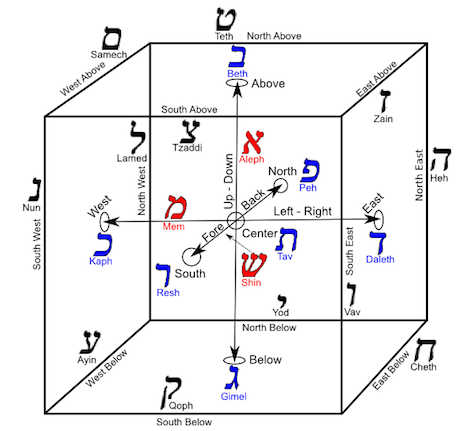
Expanding and shifting this cube of space to its multidimensional and higher iteration is the Cube of Metatron. Twenty-two lines/paths in the Cube expand to seventy eight lines in Metatron’s cube, each line begetting an archetypal form unveiled in the Major, and Major and Minor Arcana, respectively. Physicist Michio Kaku notes “Each subatomic particle represents a note on a vibrating string or vibrating membrane. We now have a candidate for the “mind of God” that Einstein wrote about for the last 30 years of his life, the “mind of God” in this picture is cosmic music resonating throughout 11 dimensional hyperspace,”[viii] This is a beautiful and lucid articulation of Qabalistic metaphysics, in harmony with budding theoretical physics.
In the western mystery tradition the Tree of Life is the dynamic structure through which consciousness transforms itself into the four elements in the dimensions of energy, matter, time and space. The eleven objective Sephiroth or dimensions are connected through twenty-two subjective pathways, corresponding to the twenty-two letters of the Hebrew alphabet and the archetypal keys of the Major Arcana. Similar in intent to eastern mandalas and yantras, the twenty-two Major Arcana are an archetypal journey into a 5th dimensional state and integration with the Source network. The Soul’s journey around the Cube of Space into reunion with the central point was first articulated in the Qabalistic Book of Formation, and developed further by Builders of the Adytum founder Paul Foster Case in the early 1900s. This journey elevates and expands individual consciousness from a water-based neurochemical soup, to a consciousness tuned into the subtle frequencies permeating space, towards the ultimate state of integration with the sub-atomic Source Intelligence network. The primeval geometric instruments used in the orchestration of creation find expression in nearly every wisdom tradition.
Eight symbols give rise to the 64 hexagrams of the I Ching; the first binary system, ultimately leading to 64bit computing. There are 64 classical arts listed in many Indian scriptures. The perfected Qabalistic structure is a 64 star tetrahedron, the Merkabah. The outside of a 64 tetrahedron has 144 faces, a significant number in the Juedo-Christian tradition. Its structure is a cubeoctahedron or vector equilibrium described by Buckminster Fuller, with eight star tetrahedrons placed into the negative space of the central, perfectly equilibrated form.
Physicist Nassim Haramein arrived at a 64 tetrahedral structure as the fundamental form of “space”. In a recent paper “Quantum Gravity and the Holographic Mass”[ix] Haramein accurately predicts the charge radius of the proton months prior to the LHC providing updated measurements. He exposits the structure of space as “Spherical plank units in a generalized holographic approach”, or a three dimensional Flower of Life. In an earlier paper with Dr. Elizabeth Raucher he demonstrates that space-time is not simply curved to produce gravity, but also curled, like water flowing down a drain[x].
The governing principle for this flow is what the mystery schools have taught for millennia and physicists Nima Arkani-Hamed and Jaroslav Trnka’s recent description of the amplituhedron[xi] elucidates in modern physics; geometry is the underlying organizing principle and key to unifying and understanding interactions between the macro and microcosmic.
[x] Haramein, Nassim. Raucher, Elizabeth. THE ORIGIN OF SPIN: A CONSIDERATION OF TORQUE AND CORIOLIS FORCES IN EINSTEIN’S FIELD EQUATIONS AND GRAND UNIFICATION THEORY
We have seen earlier that the universe in its un-manifest state is filled with luminescent cuboids and there was a trigger in the form of Pranava which started the absolute time and gave forth visual forms and aural forms. This process of evolution is depicted very nicely in the following diagram…
The square (in 2D) which is an 8×8 energy grid became a 9×9 energy grid which is manifest / gross. The transition forms were an octagon and a circle. Aintiram suggests how this transition takes place. Present physics accepts that a pulse and a sine wave can be created from each other and this happens because of simple addition of harmonic frequencies. The primordial pulsation initiates a rotational force and this rotational force as it gains momentum converts the square into a circle and if you notice that the octagon is just an in between state between a square and a circle.
We see confirmation of the details of this manifestation process in Chapter 9, verse 8 of the Bhagavad Gita where Lord Krishna describes His manifestation process to Arjuna, “prakritim svaam avastabhya visrijaami punah punah”, which means “Curving back onto myself, I create again and again…”
What it suggests is that the essential shape of every gross form in its natural state is a circle (in 2D) and a sphere in (3D). This is the reason we find every planetary body is almost spherical in shape and this is also the reason as to why the ripples in a water body when we throw a stone in the water are in circles. Be it the center of a tornado or the shape of a hurricane or a tsunami it always a circular force. The supreme secret in martial arts is that the Chi moves in a circular fashion and hence Tai Chi is the most deadly form of martial arts. Lord Vishnu has Chakra as his weapon to suggest not only light but also the rotational force.
The process of manifestation is captured in these 2 pictures at all the significant stages. If you notice that a single dot becomes multiple dots, then a line, then a pulse and then goes on to becoming a 8×8 energy grid and then to a 9×9 energy grid. 8×8 is un‐manifest and 9×9 is manifest. These aspects are very well captured as sutras in the book Aintiram and Pranava Vedam.
Subtle Energy becomes gross universe and the fundamental 5 elements are created in the process.
It is said that 1/10th of the space becomes Air, 1/10th of air becomes Fire, 1/10th Fire becomes Water and 1/10th of Water becomes Earth.
So we can conclude that we are living in a Space delineated world.
Vastureva Vaastu – Vastu which is unmanifest and subtle becomes Vaastu which is manifest and gross.
If we assume that Paramaanu is God particle and hence it is divine, then everything in this world is divine. See the oneness in all and see “All in one”.
All beings in the universe are divine. There is nothing without that divine energy or particle – however we call it. This is Universal, Open source, All Compassing and the highest state of Consciousness.
To summarize…
We all note that Subtle has become Gross. Hence conceptually Gross = Subtle or both are proportionate.
We all note that Space has become Earth. Hence conceptually Space = Earth or both are proportionate.
We all note that 8 have become 9. Hence conceptually 8 =9 or both are proportionate.
We all note that ENERGY has become MATTER. Hence conceptually ENERGY = MATTER or both are proportionate. This is represented by E = mc2 by our great scientist Einstein. While we did not have this specific formula, the concept and the associated texts were very much with us for ages.
Now let’s try to answer this question. When you throw a stone in water / pond the ripples that form take the shape of a circle (in 2D) / sphere (in 3D). Can you guess what the shape of the ripple would be if you throw the same stone in space? You would have probably guessed the answer. The ripples in space should be and would be in square /cube in shape.
Reference
1. Time = Space by Raguram Gopalan, http://ragsgopalan.blogspot.com
2. Fabric of The Universe: The Origins, Implications, and Applications of Vastu Science By Jessie J. Mercay
In our earlier articles on manifestation process called Vastureva Vaastu which gives rise to a set of principles and a mathematical order. The application of those principles to poetry, dance, music, sculpture and architecture gives rise to vibrating living forms. These fundamental principles help us better to understand the relation between every letter or word with corresponding light and sound…
The whole of cosmic structure is effected and maintained by innumerable streams of manifestation. These streams are subsumed under two categories:
Cosmic flux of sound called sabhda prapanca and
Cosmic flux of light modified into worldly objects called artha prapanca.
Both realms of sound and light are well balanced by the rhythmic creative order of the Divine. The beauty of the Divine order could be seen in the symmetrical, balanced and simultaneous existence of both the subjective world (sabda prapanca) and the objective world (artha prapanca). Both quality wise and quantity wise, this balance, symmetry and simultaneity are maintained. For example, if there emerge 100 forms on the subjective side, simultaneously and correspondingly there emerge 100 forms on the objective side. Only on this account, the science of grammar of language maintains that all the words are denotative of their corresponding referents/objects. There is no empty word bereft of referent-significance and there is no object with out being characterized by relevant sound-significance. Sabda prapanca and Artha prapanca are always interdependent.
Mamuni Mayan, having impeccably known the subtle principles of the science of manifestation, sets forth this cosmic balance maintained between sound-forms and light-forms. In Aintiram, the Key-work of Mayan, one of the Sutras reads: “Oli-Oli vadivaay ongum elutte.” Peripherally this means: “Letter is ever rising and functioning in the form of both light and sound.” But apart from this peripheral meaning, we could observe the multiple dimensions of meaning as radiating from the sutra. The main source of such radiation of multiple meanings is the term ‘eluttu’.
‘Eluttu’ is derived from the word ‘elu’ meaning ‘the creative urge’, ‘excited to manifest’, ‘operative stir’. As such, the different meanings of the term ‘eluttu’ as conceived by Mayan are – letter/phoneme, pranava – the primal letter, the inexhaustible cosmic stuff, the imperishable existence (akshara), square mandala, sculptured object and so forth.
It is generally understood that letter or phoneme (defined in the dictionary as: Any of the minimal units of speech sound in a language that can distinguish one word from another.) is concerned with sound only. Sound and light are inseparable and as such each letter is charged with sound energy and light energy. For example, ‘a’ is associated not only with its articulated sound but also with its own luminous form characterized by color, emerging factor and relevant function. The Vatulagama states (2:35):
“‘a’ is of the nature of all divinities; it is red; it is capable of bringing all the existents into its fold.”
This means that ‘a’ is inseparably associated with multi-divine factors, red color and the power of unfolding or enfolding. The luminous form ‘a’ itself is constituted by four energies, as the Paushkaragama puts it (8:13):
“On the top of ‘a’ is Paudri; on its face is Vama; on its sides exists Ambika. Jyeshta Sakti is in the middle, like a staff.”
This is how the actual subtle form of ‘a’ appears. Similarly, all other letters from ‘a’, ‘i’, etc, have their own subtle forms constituted by many other saktis. Since all the letters are charged with and energized by different potencies, they function as the creative and regulating powers of the universe. They are not inert letters. Actually there is no such letter as marred with inertness.
Every word or letter is derived from the Divine-I-Consciousness, which is with constant creative urge expressed by its ever-going ‘spanda’ or ‘throb’. This consciousness is called ‘the Supreme Verbum (paraa vaak).
The one to one correspondence between sound and light is maintained at all levels. If there rises one shoot of sound from the Supreme Verbum, simultaneously there arises a shoot of light. Sound forms and light forms are the simultaneous manifestation from the primal source of creation. The energy of the Supreme Verbum flows into various letters from ‘a’ to ‘ksa’, which as conscious forms of energy brings about the manifestation
Reference
1. The Science of Manifestation by Michael Borden, http://www.vastu-design.com/seminar/7.php
2. Fabric of The Universe: The Origins, Implications, and Applications of Vastu Science By Jessie J. Mercay. Text and diagrams, with permission, from Dr. Jessie Mercay, Fabric of the Universe, http://www.aumscience.com and aumscience.com/wordpress




 Known is a drop, Unknown is an Ocean
